
Jonathan Edwards kept a lifelong practice of reading and thinking with pen in hand: the “Miscellanies” eventually grew to more than 1,400 private notebook entries where ideas were tested, images turned over, and arguments sketched before they appeared in sermons or treatises. They served as a veritable theological workshop. Nearly everything he wrote connects back to those pages. It’s the closest we get to watching him think.
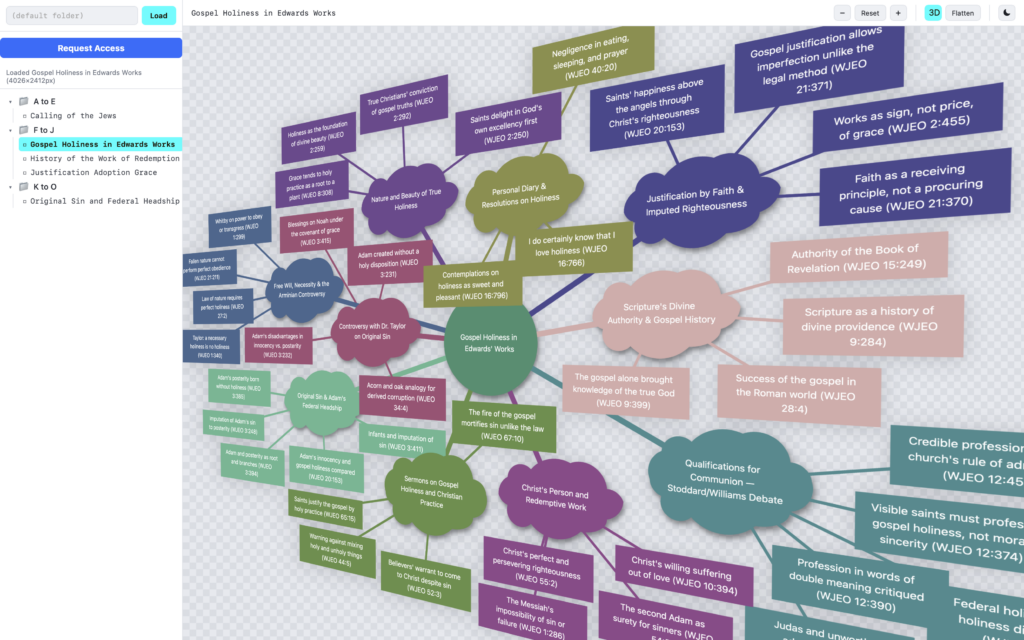
Visual Edwards is built around that fact. Today we’re launching the next phase: a completely-rebuilt desktop viewer at visualedwards.org/viewer/.
From private notebooks to vivid maps
The project began over a decade ago with Edwards’s “Images of Divine Things” and quickly expanded to the “Miscellanies,” then the full 73-volume Yale edition. Instead of searching 73 separate volumes, Visual Edwards starts at the root: an idea’s first appearance in the notebooks to maps that span the entire corpus.
What began as an idea in 2017 has grown into a library of hundreds of visualizations (currently being converted) and has become the conceptual foundation for books, the forthcoming Jonathan Edwards Commentaries on the New Testament, and the broader Edwards ecosystem of typology, emblems, and wearable theology.
What’s new
The rebuilt viewer is faster, cleaner, and more fluid:
- Smooth zoom and pan
- True 3D tilt view
- Organized browsing
- Light and dark mode
- References with words, not just data points
Who it’s for
Graduate students, pastors, independent scholars, and serious readers.
If you’ve ever wanted to “see” Edwards’s ideas, here are the maps! Request free access at visualedwards.org/request-access/ and start exploring with the desktop viewer.